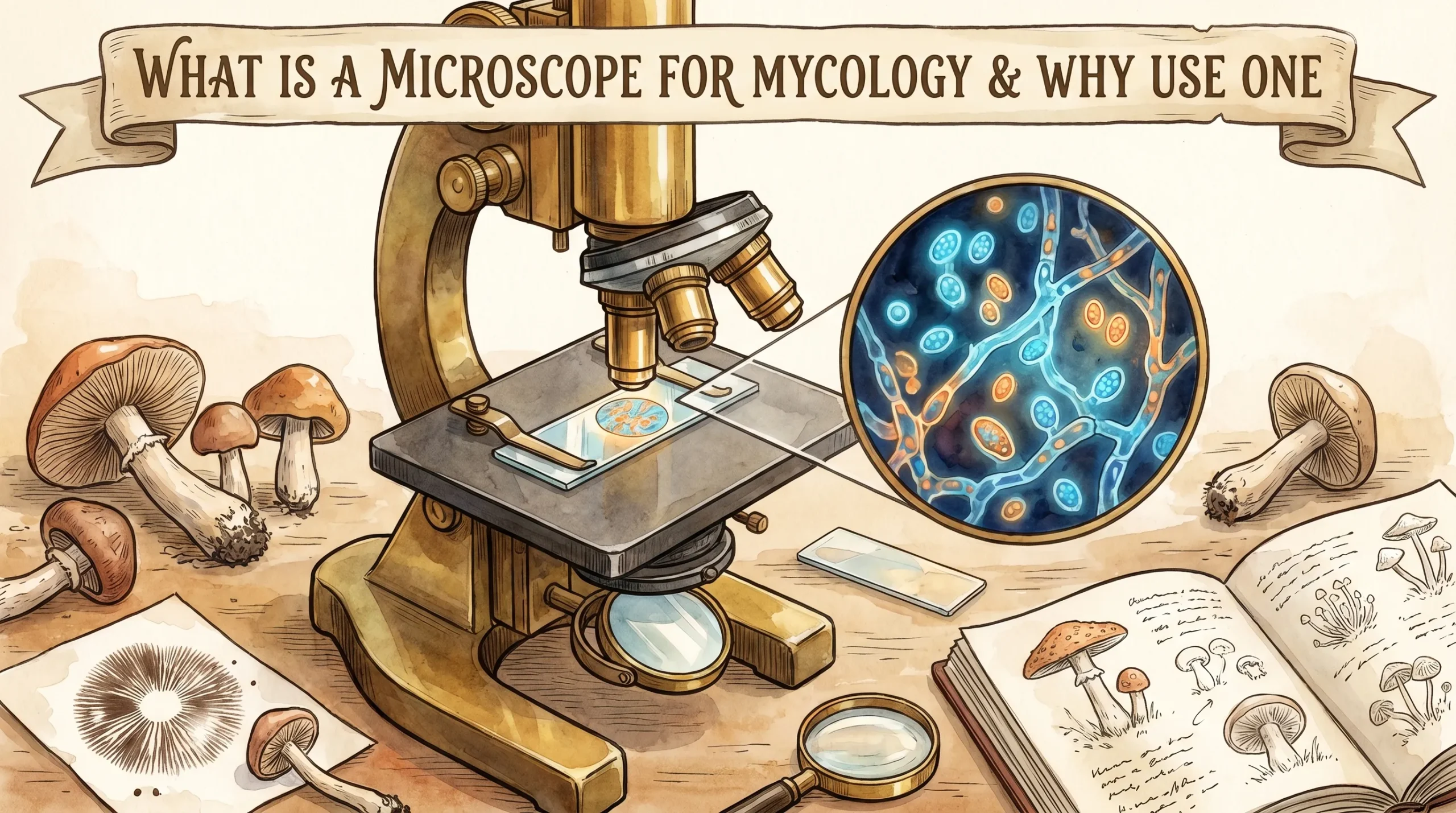
Fungi hide their most important traits at a scale that your eyes cannot see. A microscope for mycology reveals spores, hyphae, and tissue structures that separate one species from another. With the right setup you can confirm identifications, spot contamination early, and document features for research or learning.
If you are a hobbyist, cultivator, student, or lab professional, a microscope quickly becomes an essential tool.
A stereo microscope helps you inspect fresh collections, clean specimens, and prepare slides. A compound microscope lets you study microscopic details at 400x to 1000x, measure spores with an eyepiece reticle, and observe features like cystidia and basidia with strong contrast and good lighting.
Microscope for mycology: What and why
When you study fungi, you need to see details that your eyes cannot detect. A microscope for mycology gives you the power to observe the tiny structures that define different species. You use it to examine spores, hyphae, and other microscopic features. This tool helps you understand the unique characteristics of fungi and supports accurate identification.
Main features
A microscope for mycology stands out because it offers specific features designed for fungal study. You often need high magnification, sometimes up to 1000×, to see the smallest spores and cellular details. The objective lenses play a key role. They must have the right magnification and numerical aperture (NA) to provide clear images.
The NA affects how much detail you can see. A higher NA lets you distinguish smaller structures, which is essential for mycology.
You also benefit from a good condenser. This part sits below the stage and focuses light on your sample. For the best results, the condenser should match the NA of your objective lens. Many microscopes for mycology use Köhler illumination. This system uses an Abbe-type condenser with a movable diaphragm and centering mechanism. It gives you even lighting and sharp images.
Widefield oculars help you see more of your sample at once, and high-point eyepieces make viewing comfortable, even if you wear glasses.
Types of microscopes
You can choose between two main types of microscopes for mycology: stereo and compound. Each type serves a different purpose in fungal study.
|
Microscope Type |
Magnification |
Ideal Use |
Key Strengths |
|---|---|---|---|
|
Stereo |
10–50× (up to ~100×) |
Dissection, surface inspection |
3D view, large samples, live manipulation |
|
Compound |
40–1000× |
Microscopic taxonomy |
Detailed cellular resolution |
A stereo microscope lets you look at the surface of mushrooms and other large samples. You see a three-dimensional view, which helps when you want to dissect or manipulate specimens. A compound microscope gives you much higher magnification. You use it to study spores, cells, and fine structures. This type is essential for identifying fungi at the microscopic level.
Uses in mycology
You use a microscope for mycology in several important ways. First, you can measure spores. Many fungi have spores that look similar, but their size and shape help you tell them apart. Accurate measurement requires high magnification and clear resolution. You also use the microscope to examine hyphae, cystidia, and other microscopic features. These structures often hold the key to correct identification.
When you study contaminated samples, the microscope helps you spot unwanted fungi or bacteria. This is important in both research and practical applications, such as mushroom cultivation.
A microscope for mycology supports your work by revealing details you cannot see otherwise. It helps you make accurate observations, compare species, and document your findings. With the right microscope, you gain a deeper understanding of the fungal world.
Choosing a microscope for mycology
Key specifications
When you select a microscope for mycology, you need to focus on several important features. High magnification is essential. You should look for a microscope that reaches at least 400x, but 1000x is better for viewing spores and fine details. Clarity matters as much as magnification.
A good numerical aperture (NA) helps you see sharp images of fungal structures.
Oil immersion objectives can boost resolution, especially when you study tiny spores. Lab-grade quality ensures durability and consistent performance. Many modern microscopes now include digital imaging, which lets you capture and analyze images for better documentation and sharing.
Applications
You use a microscope for mycology in many practical ways. Here are some common applications:
-
Detecting fungal contamination, such as Trichoderma spores, for disease prevention.
-
Identifying fungal spores early, which helps you predict and manage plant or crop diseases.
-
Diagnosing contamination by observing urediniospores and conidial spores.
-
Examining spore shape, color, and texture to classify fungal species.
-
Using digital imaging tools to speed up and improve the accuracy of fungal identification.
These applications show how a microscope for mycology supports research, teaching, and even commercial mushroom cultivation.
Selection tips
If you are new to mycology, start with a compound microscope that offers at least 400x magnification. Look for models with clear optics and easy-to-use controls. Many training centers and online courses can help you learn basic techniques. Some facilities provide access to advanced microscopes and real-time camera displays for hands-on learning. You may face challenges, such as identifying a wide range of fungal species or preparing samples correctly.
Practice and proper training will help you overcome these obstacles. If you want to compare popular models, consider this table:
|
Brand/Model |
Type |
Magnification Range |
|---|---|---|
|
Swift SW380T |
Compound |
Up to 1000x |
|
Meiji Techno EMZ series |
Stereo |
10x to 50x |
|
Meiji Techno Compound |
Compound |
40x to 1000x |
By focusing on these specifications and resources, you can choose the right microscope for mycology and improve your fungal studies. A microscope for mycology lets you see spores and hyphae clearly, which is essential for accurate identification.
FAQ
What magnification do you need for mycology?
You need at least 400x magnification to view spores. For detailed study, choose a microscope that reaches 1000x with oil immersion objectives.
What features make a microscope suitable for mycology?
You should look for high magnification, clear optics, adjustable illumination, and sturdy construction. Widefield eyepieces and oil immersion objectives help you see fungal structures clearly.
What can you observe with a mycology microscope?
You can observe spores, hyphae, fruiting bodies, and contamination. These details help you identify fungi and understand their unique characteristics.