Look at the side of a microscope objective and you will find something like “40x/0.65”, which looks like a locker combination. The second number is the numerical aperture (NA), and it describes how much light the lens can gather and how fine a detail it can resolve. This article covers the definition, the formula, resolution, immersion oil, how to read objective markings, and the mistakes beginners make most often.
- Key Takeaway
- What Is Numerical Aperture in a Microscope?
- The Formula Without the Fear
- Why NA Matters: Resolution, Brightness, and Trade-offs
- NA vs. Magnification: Why Bigger Is Not Always Better
- Dry, Water, and Oil Objectives: Why Immersion Exists
- How to Read an Objective (and the Condenser Too)
- Common Beginner Mistakes and Quick Fixes
- Sources and Further Reading
- Final Thoughts
- FAQ
Key Takeaway
-
Definition: NA measures the range of angles over which an objective can accept light from the specimen.
-
Formula: NA = n × sin(θ).
-
Benefits of higher NA: better resolution and, generally, a brighter image.
-
Costs of higher NA: shallower depth of field and usually a shorter working distance.
-
NA vs. magnification: magnification makes the image bigger. NA decides whether there is real detail to see.
What Is Numerical Aperture in a Microscope?
Think of a bucket in the rain. A wider opening catches more rain, and a wider acceptance angle lets an objective catch more light from the specimen. NA is the optical way of describing how wide that opening is.
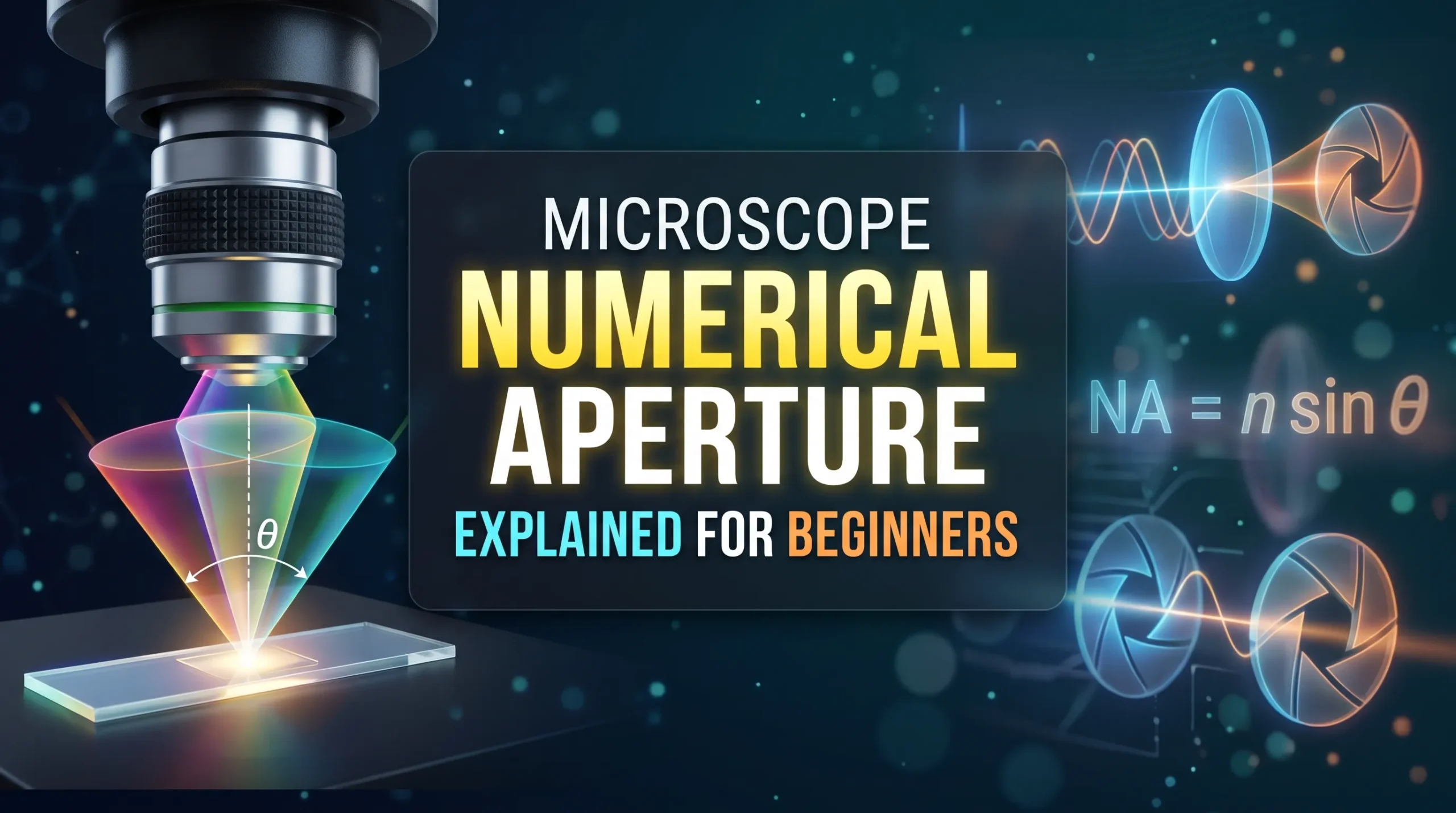
The objective accepts a cone of light. The angle θ is the half-angle of that cone, measured from the optical axis to the outermost ray the lens can take in. The other ingredient is n, the refractive index of the medium between the specimen and the front lens. Air is about 1.0, and denser media bend light more. Teaching resources from Nikon MicroscopyU and Molecular Expressions at Florida State University define NA in these terms, and Wikipedia’s numerical aperture article gives a general overview.
The Formula Without the Fear
NA = n × sin(θ)
-
n is the refractive index of the medium in front of the lens.
-
θ is the half-angle of the light cone.
-
sin(θ) is the only trigonometry you need today. It can never exceed 1, because no angle has a sine bigger than 1.
A dry objective works in air, where n is about 1.0, so its NA cannot exceed 1.0. In practice, dry objectives top out somewhat below that. To go higher, you change n.
|
Medium |
Approximate refractive index |
Where to verify |
|---|---|---|
|
Air |
about 1.0 |
|
|
Water |
about 1.33 |
|
|
Glycerol |
about 1.47 |
|
|
Immersion oil |
about 1.515 |
Why NA Matters: Resolution, Brightness, and Trade-offs
Resolution is the smallest distance at which two points still look like two points. Two classic relationships describe it:
-
Rayleigh criterion: d = 0.61 λ / NA
-
Abbe limit: d = λ / (2 NA)
The constant changes with the criterion, but the pattern is the same: bigger NA gives a smaller d, which means finer detail. For a deeper look at the physics, see Wikipedia on angular resolution.
These values use the Rayleigh formula with green light at 550 nm. They are calculated illustrations, not measurements.
|
NA |
Calculated resolvable distance |
|---|---|
|
0.25 |
about 1.34 µm |
|
0.65 |
about 0.52 µm |
|
1.25 |
about 0.27 µm |
Brightness also improves with NA, because a wider cone collects more light. The effect depends on the objective design and the illumination, so treat it as a tendency rather than a guarantee. Evident’s Learning Center discusses how NA relates to image brightness and resolution.
Trade-offs are the fine print. As NA rises, depth of field usually shrinks and working distance usually drops. A high-NA lens gives you a razor-thin slice of reality, and the rest of your specimen is politely out of focus. The lens may also sit uncomfortably close to the slide.
NA vs. Magnification: Why Bigger Is Not Always Better
Magnification enlarges the image. NA sets how much detail the lens captured in the first place. Enlarging past what the NA can resolve is called empty magnification, and it only gives you a bigger blur. It is like zooming into a low-resolution photo and discovering that the pixels are very large.
A commonly cited guideline for useful magnification is roughly 500 to 1000 times the objective NA. Under that rule, a 0.65 NA objective is useful up to about 325x to 650x total magnification. Check this range against Nikon MicroscopyU or the ZEISS Microscopy Campus before relying on it for a specific instrument.
|
Property |
Magnification tells you |
NA tells you |
|---|---|---|
|
Image size |
How large the image appears |
Nothing directly |
|
Detail |
Nothing about real detail |
The finest detail the lens can resolve |
|
Brightness |
Little |
How much light the lens can collect |
Dry, Water, and Oil Objectives: Why Immersion Exists
Light leaving a slide through glass and then air bends away, and the steepest rays never reach a dry lens. Fill the gap with a medium closer to glass in refractive index, and those rays get in. A higher n in the NA formula allows a higher NA.
|
Objective type |
Typical medium |
Typical NA range |
Typical use |
|---|---|---|---|
|
Dry |
Air |
about 0.1 to 0.95 |
General survey and routine work |
|
Water immersion |
Water |
about 0.9 to 1.2 |
Living specimens in aqueous solution |
|
Oil immersion |
Immersion oil |
about 1.25 to 1.4 |
High-resolution fixed specimens, such as stained smears |
These ranges are typical, not universal. Check the manufacturer’s specifications, such as those on the Leica Microsystems Science Lab or in Thorlabs microscope objective documentation.
Some practical tips:
-
Use only the oil the objective is designed for.
-
Clean the lens after use, following the manufacturer’s instructions.
-
Never put oil on a dry objective.
Immersion oil is the one time a lab encourages you to add a drop of something slippery on purpose. Treat it with respect, and it will treat you with a sharper image.
How to Read an Objective (and the Condenser Too)
|
Marking |
Meaning |
|---|---|
|
40x |
Objective magnification |
|
0.65 |
Numerical aperture |
|
160 |
Mechanical tube length in mm (an infinity symbol appears on infinity-corrected lenses) |
|
0.17 |
Coverslip thickness in mm |
|
Oil, W, or similar |
Immersion medium |
Markings vary by manufacturer, so check your manual.
The condenser has an NA too. If it is set far below the objective’s NA, you will not get the full resolution of the objective. Köhler illumination is the standard setup procedure for getting the best from both, and the ZEISS Microscopy Campus and Nikon MicroscopyU both explain it.
Common Beginner Mistakes and Quick Fixes
|
Mistake |
Fix |
|---|---|
|
Buying on magnification alone |
Compare NA first. A bigger number on the box is not a sharper picture. |
|
Closing the condenser aperture too far |
Set it with Köhler illumination as a starting point, then adjust slightly for contrast. |
|
Leaving the condenser wide open for everything |
Adjust it per specimen, since glare can wash out contrast. |
|
Using the wrong oil or a dirty lens |
Use the specified oil and clean after each session. |
|
Expecting depth and high NA together |
Accept the thin focal plane and refocus often. |
Sources and Further Reading
I was not able to open these pages while drafting. Confirm that each URL is live and that the values quoted above match the page before publishing.
|
Source |
What it supports |
Section cited |
|---|---|---|
|
NA definition, refractive indices, useful magnification |
Definition, formula, NA vs. magnification |
|
|
NA, resolution, and brightness |
Why NA matters |
|
|
Köhler illumination, magnification guidance |
NA vs. magnification, condenser |
|
|
NA explanation and angle |
Definition, formula |
|
|
General NA overview |
Definition |
|
|
Basic microscope principles |
Background |
|
|
NA and resolution background |
Why NA matters |
|
|
Objective specifications |
Immersion table |
|
|
Objective markings and specifications |
Immersion table, reading objectives |
|
|
Diffraction limit, resolution |
Why NA matters |
Final Thoughts
NA governs how much light an objective gathers and how much detail it can resolve, and magnification cannot make up for a low one. Look at the objectives on your own microscope, write down their NA values, and compare them with the resolution table above. NA is the quiet number on the lens barrel that decides how good your view will be, and it never asks for credit.
FAQ
What is a good numerical aperture for a beginner microscope? Typical values are about 0.10 for 4x, 0.25 for 10x, 0.65 for 40x, and 1.25 or higher for 100x oil objectives. These vary by manufacturer and lens quality, so use them as rough guides.
Can numerical aperture be greater than 1? Yes, with immersion media. Water, glycerol, or oil raises n above 1.0, which allows NA values above 1.
Does higher NA always mean a better image? No. Higher NA brings a shallower depth of field, a shorter working distance, and usually a higher price.
Is NA the same as magnification? No. Magnification sets image size, and NA sets the detail the lens can capture.
Why does my high-NA image look dim or blurry? Check the condenser setup, coverslip thickness, oil, and lens cleanliness. Any of these can cost you resolution.
Do I need immersion oil? Only for objectives marked for oil. Dry objectives work without it, and putting oil on one can damage it.