
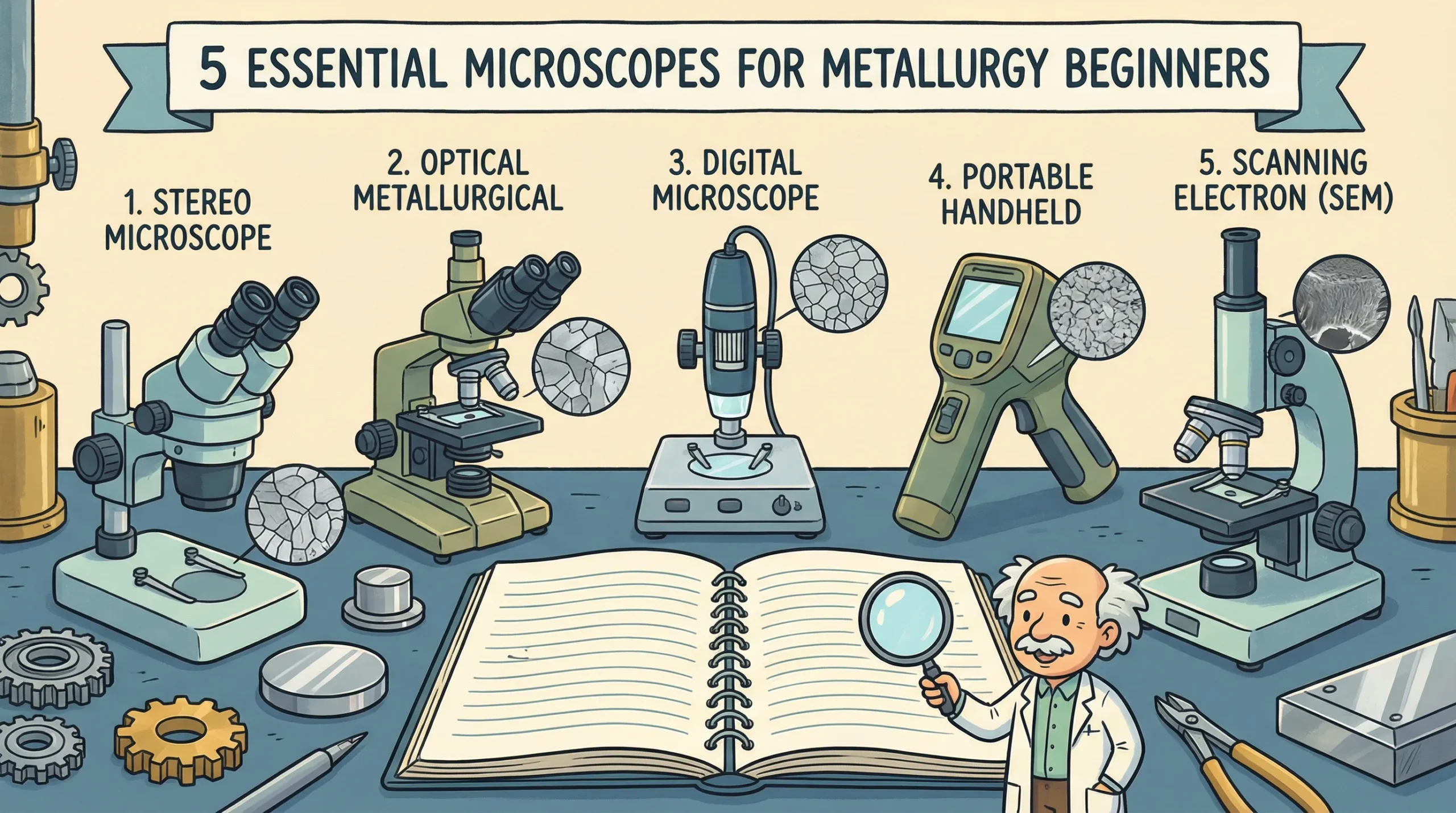
Starting your metallurgy journey can be both exciting and challenging. For beginners, selecting the right microscope for metallurgy is crucial for your learning experience. Here are five essential microscopes that will guide you through the intricate world of metal structures:
-
Optical Microscope: Offers simplicity and versatility.
-
Stereo Microscope: Provides a three-dimensional view.
-
Metallurgical Microscope: Specialized for metal analysis.
-
Scanning Electron Microscope (SEM): Delivers high-resolution imaging.
-
Digital Microscope: Facilitates easy documentation.
Picking the appropriate microscope enhances your understanding and fosters effective learning in metallurgy.
1. Optical Microscope
As you begin your metallurgy studies, you’ll discover the optical microscope is an incredibly useful tool. It opens the door to understanding the complex structures of metals, and its ease of use and adaptability make it perfect for newcomers.
Features
Magnification capabilities
The Optical Microscope offers impressive magnification capabilities. You can explore microstructures with magnifications ranging from 40x to 1600x. This range allows you to observe fine details in metal samples, providing a clear view of the internal structures.
The multiple lenses employed in this microscope ensure high optical resolution, making it suitable for detailed specimen observation.
Ease of use
Ease of use is a hallmark of the Optical Microscope. Its straightforward design allows you to focus on learning rather than grappling with complex operations. The intuitive controls and clear optics make it accessible, even if you’re new to microscopy. This user-friendly nature encourages you to explore and experiment with different samples confidently.
Benefits
Cost-effectiveness
For beginners, cost-effectiveness is a significant advantage of the Optical Microscope. It provides high-quality imaging without the hefty price tag associated with more advanced models. This affordability ensures that you can access essential tools without straining your budget, making it a practical choice for educational purposes.
Versatility in applications
The versatility of the Optical Microscope extends beyond metallurgy. You can use it for various applications, from biological studies to material science. This adaptability allows you to explore different fields, broadening your understanding and enhancing your learning experience.
Why Suitable for Beginners
Simple operation
The Optical Microscope stands out for its simple operation. You can quickly learn to adjust the focus and magnification, enabling you to concentrate on analyzing samples. This simplicity fosters a smooth learning curve, allowing you to gain confidence in your microscopy skills.
Basic understanding of microstructures
As a beginner, developing a basic understanding of microstructures is crucial. The Optical Microscope provides a clear view of these structures, helping you grasp fundamental concepts in metallurgy. Observing and analyzing samples allows you to construct a robust foundation for subsequent studies.
2. Stereo Microscope
Imagine examining a metal surface and seeing it in three dimensions. The Stereo Microscope offers this unique perspective, making it an essential tool for metallurgy beginners. This microscope provides a broader view of samples, allowing you to appreciate the texture and structure of metals in a way that flat images cannot convey.
Features
Three-dimensional viewing
The Stereo Microscope excels in providing a three-dimensional view of your samples. This feature allows you to observe the depth and contours of metal surfaces, which is crucial for understanding their physical properties.
With this capability, you can explore the intricate details of metal structures, gaining insights that are not possible with two-dimensional imaging.
Low magnification
Unlike other microscopes, the Stereo Microscope operates at low magnification levels. This characteristic makes it ideal for examining larger areas of a sample without losing sight of the overall structure. You can easily switch between different magnification settings to focus on specific areas of interest, enhancing your ability to conduct thorough examinations.
Benefits
Ideal for surface examination
The Stereo Microscope is particularly suited for surface examination. Its design allows you to inspect the topography of metal surfaces, identifying features such as scratches, cracks, or other imperfections. This capability is invaluable for quality control and research, where understanding surface characteristics is essential.
User-friendly design
Ease of use is a hallmark of the Stereo Microscope. Its user-friendly design ensures that you can quickly become proficient in its operation. The intuitive controls and straightforward setup make it accessible, even if you’re new to microscopy.
This simplicity encourages you to explore and experiment, building your confidence and skills.
Why Suitable for Beginners
Intuitive handling
Handling the Stereo Microscope is intuitive, making it an excellent choice for beginners. You can easily adjust the focus and magnification, allowing you to concentrate on analyzing samples rather than struggling with complex controls.
This straightforward operation fosters a smooth learning experience, enabling you to develop your microscopy skills effectively.
Provides a broad overview of samples
For beginners, gaining a broad overview of samples is crucial. The Stereo Microscope offers this advantage, allowing you to see the big picture before delving into finer details. This perspective helps you understand the context of your observations, laying a solid foundation for more advanced studies in metallurgy.
3. Metallurgical Microscope
Delving into the world of metallurgy, you will find the Metallurgical Microscope to be an indispensable tool. This specialized microscope for metallurgy offers unique capabilities that allow you to explore the intricate details of metal structures. Its design caters specifically to the needs of metallurgists, providing insights that are crucial for both beginners and seasoned professionals.
Features
High magnification
The Metallurgical Microscope stands out with its high magnification capabilities. You can achieve magnifications ranging from 50x to 1000x, which is essential for observing the fine details of metal samples. This feature allows you to examine microstructures that are not visible with standard microscopes, providing a deeper understanding of the material’s properties.
Polarized light capabilities
Another remarkable feature is its ability to utilize polarized light. This capability enhances the contrast of the sample, making it easier to distinguish between different phases and grain boundaries. Polarized light is particularly useful in identifying stress patterns and defects within the metal, offering a comprehensive view of the sample’s integrity.
Benefits
Detailed analysis of metal structures
With the Metallurgical Microscope, you gain the ability to conduct detailed analyses of metal structures. This microscope allows you to study the microstructure and properties of metals, alloys, and other solid materials. Such detailed examination is vital for research, quality control, and manufacturing processes across various industries.
Enhanced contrast for better visibility
The enhanced contrast provided by polarized light capabilities ensures better visibility of the sample’s features. This improvement allows you to identify and analyze crystal grain boundaries and defects with greater clarity. Enhanced visibility is crucial for accurate assessments and informed decision-making in metallurgical studies.
Why Suitable for Beginners
Specialized for metal analysis
As a beginner, you will appreciate the specialization of the Metallurgical Microscope in metal analysis. Its design and features cater specifically to the examination of metals, making it an ideal choice for those new to the field. This specialization helps you focus on the essential aspects of metallurgy without unnecessary distractions.
Helps in understanding grain structures
Understanding grain structures is fundamental in metallurgy. The Metallurgical Microscope aids in this by providing clear views of grain boundaries and other structural features. By observing these details, you build a solid foundation for more advanced studies, enhancing your knowledge and skills in the field.
4. Scanning Electron Microscope (SEM)
Imagine peering into the microscopic world with unparalleled clarity. The Scanning Electron Microscope (SEM) offers you this extraordinary capability, making it an indispensable tool in metallurgy. As a beginner, you will find the SEM’s advanced features and benefits invaluable for exploring the intricate details of metal surfaces.
Features
High-resolution imaging
The SEM provides high-resolution imaging that allows you to observe the finest details of metal surfaces. This microscope uses an electron beam to scan the sample, producing images with exceptional clarity. You can see features as small as 50 nanometers, which is crucial for identifying defects and understanding material properties.
Electron beam technology
Electron beam technology sets the SEM apart from other microscopes. This technology enables you to examine the surface morphology and composition of metals with precision. By analyzing how electrons interact with the sample, you gain insights into its microstructural characteristics, aiding in quality control and research.
Benefits
Detailed surface topography
With the SEM, you can explore detailed surface topography. This capability is essential for assessing coating quality, identifying defects, and supporting failure analysis. You can visualize the texture and structure of metal surfaces, providing a comprehensive understanding of their physical properties.
Elemental analysis capabilities
The SEM’s elemental analysis capabilities allow you to determine the chemical composition of your samples. This feature is invaluable for identifying phases and understanding the distribution of elements within a material. You can conduct qualitative chemical analysis, which is crucial for research and development in metallurgy.
Why Suitable for Beginners
Advanced insights into material properties
As a beginner, the SEM offers you advanced insights into material properties. You can explore the microstructure and composition of metals, gaining a deeper understanding of their characteristics. This knowledge is vital for developing your skills and enhancing your learning experience in metallurgy.
Exposure to cutting-edge technology
Using the SEM exposes you to cutting-edge technology in the field of microscopy. This experience broadens your understanding of modern analytical techniques and prepares you for more advanced studies. Working with the SEM allows you to acquire useful skills that can be applied in a range of scientific and industrial fields.
5. Digital Microscope
In the modern age of technology, the Digital Microscope emerges as a powerful tool for metallurgy beginners. This microscope combines traditional microscopy with digital advancements, offering a unique and interactive learning experience.
As you delve into metallurgy, the digital microscope provides you with innovative features that enhance your understanding of metal structures.
Features
Digital imaging
The Digital Microscope excels in digital imaging, allowing you to capture high-quality images of your samples. This feature enables you to document your observations with precision, making it easier to analyze and review your findings. With digital imaging, you can zoom in on specific areas of interest, gaining a detailed view of the microstructures within metals.
Connectivity options
Connectivity options are a standout feature of the Digital Microscope. You can connect the microscope to computers, tablets, or other devices, facilitating seamless data transfer and sharing. This connectivity allows you to collaborate with peers or instructors, enhancing your learning experience through shared insights and discussions.
Benefits
Easy documentation and sharing
The Digital Microscope simplifies documentation and sharing. You can easily save images and videos of your samples, creating a comprehensive record of your observations. This capability is invaluable for research and educational purposes, as it allows you to track changes over time and share your findings with others.
Interactive learning experience
An interactive learning experience is one of the key benefits of the Digital Microscope. The digital interface allows you to manipulate images, annotate findings, and engage with the material in a dynamic way. This interactivity fosters a deeper understanding of metallurgical concepts, making learning more engaging and effective.
Why Suitable for Beginners
Modern interface
The Digital Microscope offers a modern interface that is intuitive and user-friendly. You can navigate the digital controls with ease, focusing on your studies rather than struggling with complex operations. This simplicity makes it an ideal choice for beginners, providing a smooth introduction to the world of microscopy.
Facilitates collaborative learning
Collaborative learning is greatly facilitated by the Digital Microscope. You can share your observations and insights with classmates or instructors, fostering a collaborative environment that enhances your educational journey. This feature encourages teamwork and communication, essential skills in both academic and professional settings.
Incorporating the digital microscope into your studies opens up new avenues for exploration and discovery. Its advanced features and benefits make it an indispensable tool for anyone starting their journey in metallurgy.
As you begin your journey in metallurgy, keep in mind the five essential microscopes that can significantly enrich your learning. The Optical Microscope is valued for its straightforwardness and adaptability, whereas the Stereo Microscope provides a three-dimensional perspective. The Metallurgical Microscope specializes in metal analysis, and the Scanning Electron Microscope (SEM) delivers high-resolution imaging.
Lastly, the Digital Microscope facilitates easy documentation. Choosing the right microscope for metallurgy is crucial. Consider factors like magnification, sample type, and budget. Explore and experiment with different microscopes to deepen your understanding and skills.
FAQ
What is the primary use of a metallurgical microscope?
Metallurgical microscopes primarily serve to examine the microstructure of metals and alloys. They allow you to analyze properties like grain size, surface defects, and material composition. These microscopes are essential in fields such as metallography, forensic analysis, and quality control in manufacturing.
How does a metallurgical microscope differ from a biological microscope?
A metallurgical microscope uses reflected light to view opaque materials, unlike biological microscopes that use transmitted light for transparent samples. This feature makes metallurgical microscopes ideal for examining solid metal surfaces and other non-transparent materials.
Why is high magnification important in metallurgy?
High magnification allows you to observe fine details in metal samples, such as grain boundaries and surface defects. This capability is crucial for understanding the material’s properties and ensuring quality control in manufacturing processes.
What are the benefits of using polarized light in metallurgical microscopes?
Polarized light enhances contrast, making it easier to distinguish between different phases and grain boundaries in metals. This feature helps you identify stress patterns and defects, providing a comprehensive view of the sample’s integrity.
How does a digital microscope enhance learning in metallurgy?
Digital microscopes offer digital imaging and connectivity options, allowing you to document and share observations easily. This feature facilitates collaborative learning and provides an interactive experience, making it ideal for educational purposes.
What types of samples can be examined with a metallurgical microscope?
You can examine a wide range of samples, including metals, ceramics, composites, plastics, and more. Metallurgical microscopes are versatile tools used in various fields, from semiconductor materials to solar cells and textiles.