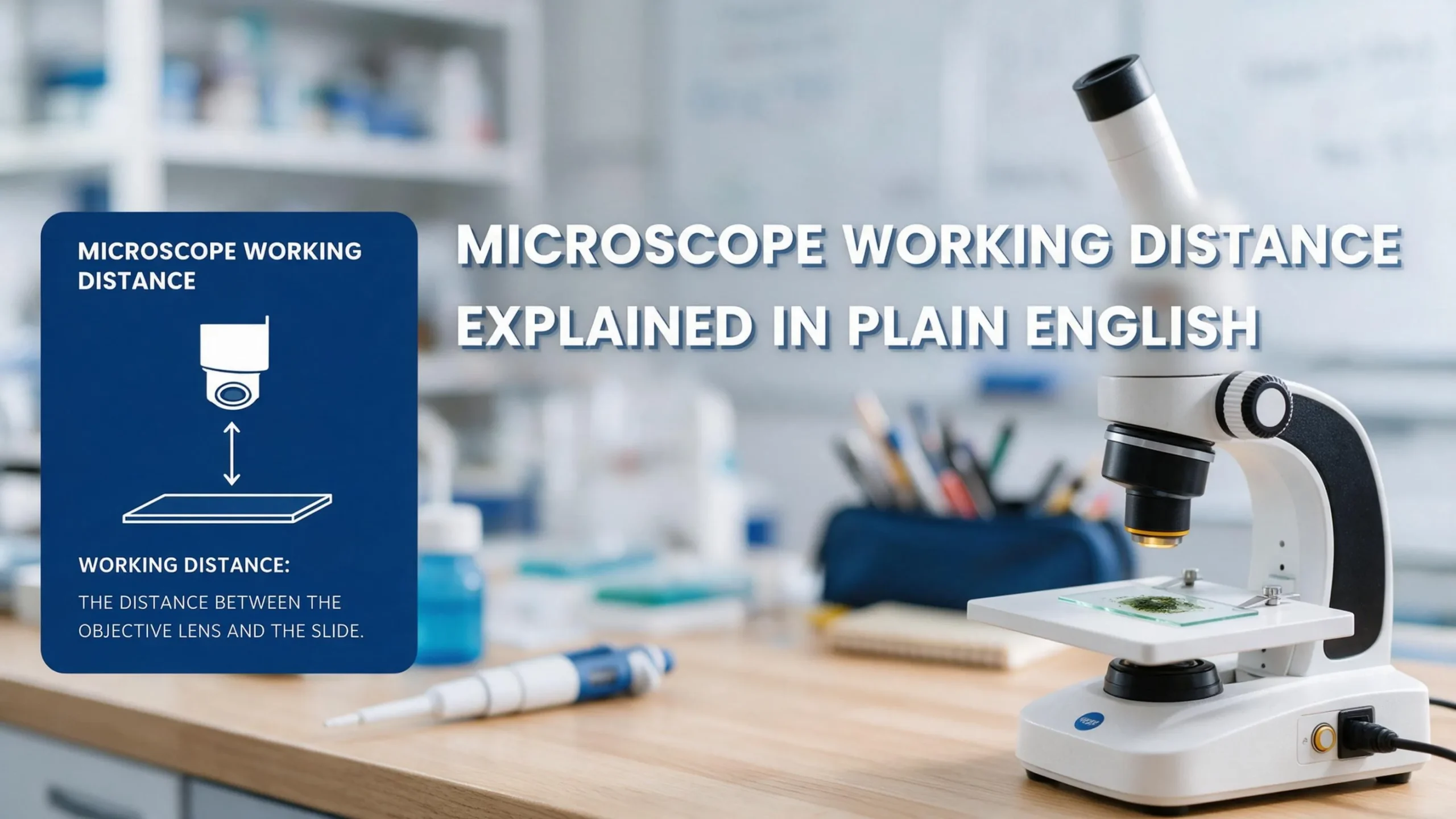
Working distance is the clear space from the front of the objective (or front lens) to the focused sample surface. Longer working distance gives better room for tools, thick vessels, and fixtures, but often trades some resolution or brightness at a given magnification. Match working distance to the thickest coverslip, dish, probe, or fixture you must clear. Do not chase magnification alone.
Spec sheets list WD in millimeters beside NA and magnification, yet the number only becomes real when a pipette, probe, or thick culture dish will not fit under the lens. This article defines working distance in plain language, explains the bench tradeoffs that matter, provides a comparison table grounded in manufacturer data patterns, and gives decision guidance for people who specify or run microscopes rather than design them. The audience is lab, QA, clinical, materials, and industrial users who need clearance, sample access, and optic choices that survive real work.
What Working Distance Means in Plain English
Working distance is the free gap between the lowest part of the objective (or the front lens of a stereo or macroscope) and the top of the specimen when the image is in focus. It is not stand height, not tube length, and not the distance from the eyepiece to the sample.
If the sample sits under a coverslip, dish lid, well plate, or protective film, that material occupies part of the gap. Effective clearance is working distance minus whatever sits above the plane you care about. Maker primers state the same idea in product language: Olympus’s objective basics, Nikon MicroscopyU objective specifications, and Zeiss Campus optics material all treat working distance as the free space in front of the focused lens, not a system height.
Why Working Distance Matters on the Bench
Short working distance blocks micromanipulators, soldering irons, dispensers, electrical probes, and tall fixtures. Stereo and inspection systems often keep long working distance so hands, tools, and parts stay in the field during assembly, rework, and dissection. Compound high-power objectives commonly shorten that gap as magnification and numerical aperture rise.
Crash risk is practical, not theoretical. Driving an expensive front lens into a slide, plastic dish, or metal coupon damages coatings and housings and stops work. Application notes from Leica Microsystems on stereo systems, Edmund Optics imaging resources, and Thorlabs microscope objective overviews repeatedly tie usable clearance to real handling, not only to optical theory.
How Working Distance Relates to Magnification and Other Specs
On many objectives, higher magnification and higher numerical aperture place the front lens closer to the sample, so working distance shrinks. Long-working-distance designs (often marked LWD or ELWD) restore clearance for dishes and tools. At the same magnification class they may collect less light or show different field behavior than a short-WD, high-NA counterpart.
Coverslip correction, immersion medium, and parfocal length are separate specifications. Correction collars and immersion change how you use the gap; parfocal length describes how objectives track focus when you rotate the turret. None of those terms replace working distance on the datasheet. Compare series data on Nikon MicroscopyU, Olympus objective series pages, Zeiss objective documentation, and industrial long-WD lines such as Mitutoyo M Plan Apo objectives when you need side-by-side numbers rather than marketing names.
Typical Working Distances at a Glance
Ranges below are typical order-of-magnitude values seen across major catalogs. Always verify the exact part number. Series names are not a substitute for the engraved or datasheet WD.
|
Optic type / class |
Typical free WD |
Common use case |
Source note |
|---|---|---|---|
|
Stereo / inspection objectives |
Often ~60–110+ mm depending on objective and accessory |
Assembly, rework, dissection, soldering |
Leica stereo product guidance; Edmund Optics imaging notes |
|
Low-power compound dry (e.g., 4×–10×) |
Several mm to >10 mm on many standard plans |
Survey, alignment, thick samples |
Olympus / Nikon objective spec sheets |
|
Mid/high-power dry (e.g., 40×) |
Often ~0.5–1 mm on standard designs; longer on LWD variants |
Routine slides; limited tool access |
Nikon MicroscopyU; manufacturer objective tables |
|
High-NA oil immersion (e.g., 60×–100×) |
Often ~0.1–0.2 mm |
Highest resolution on thin, prepared slides |
Olympus, Nikon, Zeiss objective data |
|
Dedicated LWD / ELWD or industrial infinity objectives |
Frequently several mm to tens of mm at moderate to high mag |
Dishes, probes, metrology, machine vision |
Mitutoyo M Plan Apo; Thorlabs objective listings |
Cross-check cells against current Olympus specifications, Nikon objective data, Zeiss objective pages, Leica documentation, Mitutoyo microscope objectives, Edmund Optics guides, Thorlabs specs, life-science imaging primers such as Thermo Fisher microscopy education material, and your local university microscopy core facility guides when a purchase decision depends on a millimeter.
How to Choose Working Distance for Your Work
-
List clearance first: sample height, vessel walls, fixtures, tool shafts, and any angled approach.
-
Set magnification and resolution needs second.
-
Only then choose standard glass versus LWD or ELWD glass.
-
For stereo and inspection work, prioritize working distance and depth of field when hands stay in the field. For high-resolution compound imaging, accept shorter WD or budget true LWD objectives that still meet NA requirements.
-
Confirm free working distance on the exact model, including dip caps, correction collars, protective windows, or adapters that consume part of the gap.
Manufacturer configurators and independent suppliers (Olympus, Nikon, Zeiss, Leica, Mitutoyo, Edmund, Thorlabs) publish the part-level numbers you need for quotes and receiving inspection.
Practical Checks and Common Pitfalls
Confirm WD from the objective barrel engraving or the official datasheet for that part number. Catalog family names are not enough. Account for coverslips, films, and dish bottoms when the plane of interest is not the top surface. Do not assume a zoom stereo keeps constant working distance across the full zoom range without checking the stand and objective combination. Avoid focusing by driving the stage up blindly; use coarse-focus awareness and, where available, focus locks or software travel limits.
Final Thoughts
Working distance is a clearance budget, not a vanity specification. Specify it from real sample and tool geometry, then accept the optical tradeoffs that follow. Reading WD next to magnification and NA on every objective quote prevents misfit purchases and tip crashes. Keep manufacturer datasheets and the comparison table above as the ongoing reference habit whenever you change vessels, fixtures, or magnification class.
FAQ
What is microscope working distance in simple terms?
It is the open space between the front of the focused objective (or stereo front lens) and the specimen surface. Maker primers from Olympus, Nikon, and Zeiss define it the same way.
Is a longer working distance always better?
No. Longer WD improves access and safety for tools and tall samples, but at a given magnification class it often means some compromise in numerical aperture, brightness, or other optical performance versus a short-WD design.
Why do high-magnification objectives have short working distances?
Higher magnification and higher NA designs typically place the front lens closer to the sample so the optic can collect a wider cone of light. That geometry shrinks free working distance unless the objective is a dedicated LWD type.
What is the difference between working distance and parfocal distance?
Working distance is the free gap above the focused sample. Parfocal distance (parfocal length) relates to how objectives stay nearly in focus when you change magnification on a turret. They solve different mechanical problems.
How much working distance do I need for cell culture dishes or well plates?
Enough free WD to clear the vessel wall or lid thickness above the plane you image, plus margin for probes or pipettes if you use them. Measure the stack height and compare it to the objective’s published free WD rather than assuming a generic “LWD” label is enough.
What does LWD or ELWD mean on an objective?
Long working distance or extra-long working distance. These markings indicate designs that preserve more clearance for dishes and tools than a standard objective in the same magnification class.
Does immersion oil change working distance?
Immersion objectives are designed for a specific medium and usually have very short free working distances. Oil fills the thin gap; it does not create tool access. Using the wrong medium also breaks the optical design.
How do I find the working distance for my exact objective model?
Read the barrel engraving and the manufacturer datasheet for that part number. If either is missing, contact the maker or supplier with the full model string. Do not rely on series brochures alone.