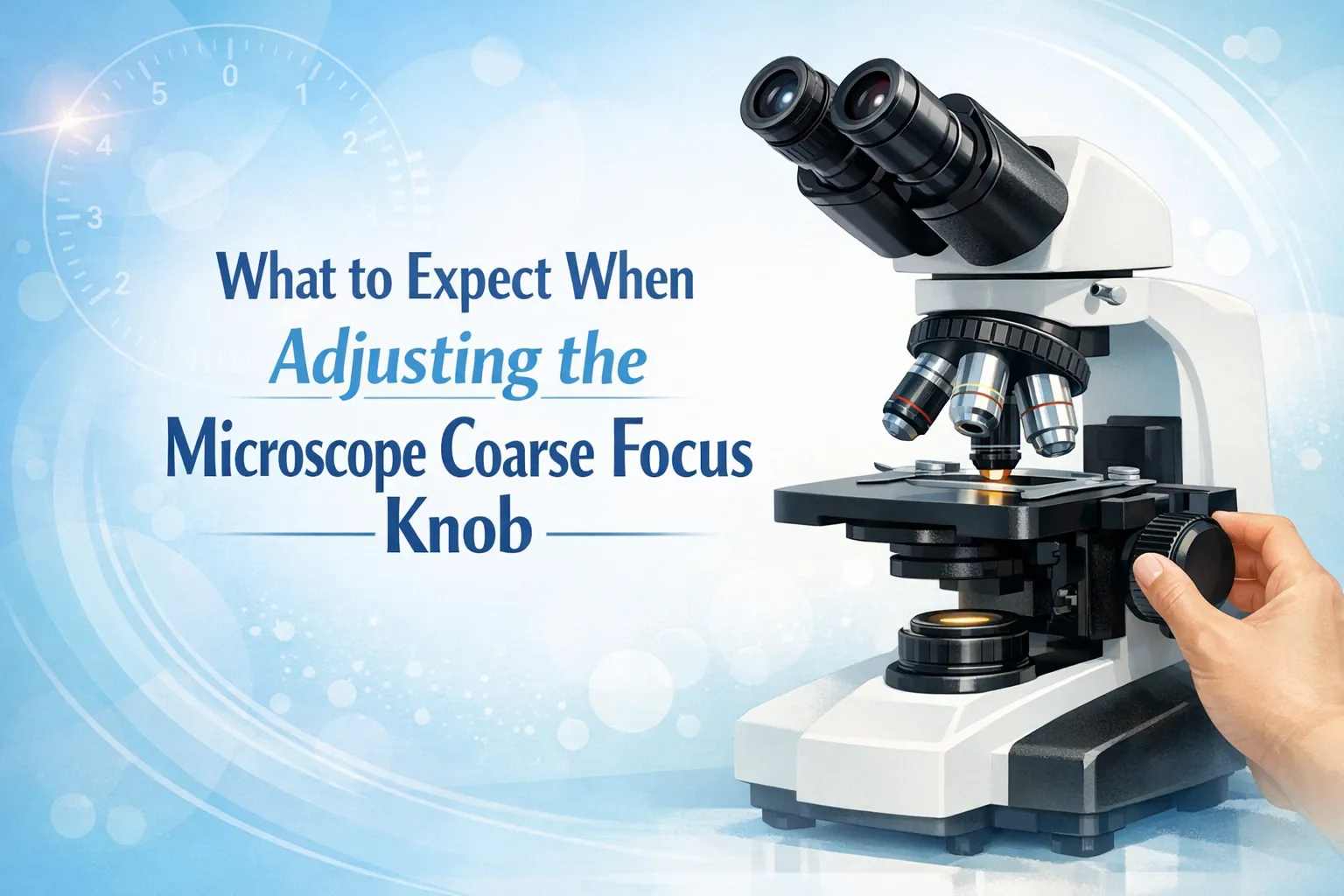
When you turn the microscope coarse focus knob, you move the stage or the objective lens quickly. This action lets you use the coarse adjustment knob to bring your specimen into view. Always use the coarse focus knob with a low power objective to avoid damaging the microscope during focus.
Key Takeaways
-
Use the coarse focus knob with low power objectives to quickly bring the specimen into rough focus without risking damage.
-
Turn the coarse focus knob slowly to move the stage or objective lens in large increments and locate the specimen efficiently.
-
Switch to the fine focus knob after the specimen is visible for precise adjustments and sharper image clarity.
How the Microscope Coarse Focus Knob Works
When you begin using a microscope, you need to understand what happens when you adjust the microscope coarse focus knob. This part of the microscope plays an important role in the initial coarse adjustment process. You will notice that the coarse adjustment knob is larger and easier to grip than the fine focus knob. Its size and design allow you to make rapid, significant changes to the focus, which is essential for bringing your specimen into view quickly. The coarse focus knob is especially important during initial focusing, as it helps you locate your specimen on the slide before you make any fine adjustments.
You should expect the microscope coarse focus knob to move either the stage or the objective lens up and down. This movement is not subtle. Instead, it covers a large vertical distance with each turn, making it possible to see dramatic changes in the image.
For example, a single full rotation of the coarse adjustment knob can move the stage as much as 20 millimeters. This rapid movement is what allows you to perform initial coarse adjustment efficiently. The coarse focus knob is designed for use with low power objectives, such as the 4x lens, where there is enough space between the lens and the slide to prevent accidental damage.
When you use the coarse adjustment knob, you will see the image come into a rough focus. The specimen may appear blurry at first, but as you continue to adjust, the details will become clearer. This process helps you quickly locate the area of interest on your slide. Once you have the specimen in view, you can switch to the fine focus knob for more precise adjustments.
The coarse focus knob is not suitable for high power objectives because the working distance is much smaller, and using it could cause the lens to hit the slide.
Moving the Stage and Objective
The coarse adjustment knob works by moving the stage or the objective lens in large increments. You will notice that turning the knob causes the stage to rise or fall quickly. This movement is possible because the knob operates through a gear mechanism that translates your rotation into significant vertical adjustments. The design of the coarse adjustment knob allows you to make large movements, which is essential for quickly locating your specimen.
-
The coarse adjustment knob enables large movements of the stage to quickly locate the specimen.
-
It operates through a gear mechanism that translates the knob’s rotation into significant vertical adjustments of the stage.
-
This design allows for rapid adjustments, making it easier to bring the specimen into general view before fine-tuning.
You can see the difference in movement speed between the coarse and fine focus knobs in the table below:
|
Knob Type |
Speed of Movement |
Movement Size |
|---|---|---|
|
Coarse Adjustment |
Rapid |
Large increments |
|
Fine Adjustment |
Slow |
Small increments |
A single full rotation of the coarse adjustment knob can move the stage by as much as 20mm. This large movement is what makes the coarse focus knob so effective for initial focusing.
Bringing the Specimen into View
When you use the coarse adjustment knob, you should expect to see large changes in the image. The specimen may move in and out of focus quickly. This is normal during the initial coarse adjustment. The coarse focus knob helps you bring the specimen into a rough focus, making it visible in the field of view. You may need to adjust the slide position or the lighting to get the best possible image.
Tip: If you have trouble seeing your specimen, check the slide position and adjust the light source. Sometimes, small changes in lighting can make a big difference.
Common challenges you might face include:
-
Potential damage to delicate specimens or objectives if you use the coarse adjustment knob with high power objectives.
-
Difficulty in achieving precise focus, which is why you should switch to the fine focus knob after the specimen is visible.
-
Issues related to slide positioning and lighting, which can affect the clarity of the image.
When to Use the Coarse Adjustment Knob
You should use the coarse adjustment knob during the initial coarse adjustment phase, especially with low power objectives. This is the best time to use the coarse focus knob because the wider field of view allows you to locate your specimen quickly. Once you have centered the specimen, you can switch to a higher magnification and use the fine focus knob for detailed focusing.
The coarse adjustment knob is ideal for:
-
Initial specimen location.
-
Changing magnification levels.
-
Shifting focus between different specimens.
You should avoid using the coarse adjustment knob with high power objectives. The working distance is much smaller at higher magnifications, and using the coarse focus knob could cause the objective lens to hit the slide. This can damage both the specimen and the microscope.
By understanding what to expect when using the microscope coarse focus knob, you can focus your specimen safely and efficiently. This knowledge will help you get the best results from your microscope and protect your equipment from damage.
Using the Coarse Adjustment Knob Safely
When you use a microscope, you want to achieve a clear image without causing damage. The microscope coarse focus knob lets you make large changes to the stage position, but you need to use it correctly to protect both your specimen and the equipment. What you do during the initial focus stage sets the foundation for sharp, detailed viewing. You should know what steps to follow and what mistakes to avoid when handling the coarse adjustment knob.
This section explains what actions to take for safe and effective focusing.
Step-by-Step Focusing Guide
Follow these steps to use the coarse adjustment knob safely:
-
Start with the lowest power objective lens. This gives you a wide field of view and a safe working distance.
-
Look through the eyepiece and slowly turn the coarse adjustment knob. Move the stage up or down until you see the specimen come into view.
-
Use the coarse adjustment knob only at low magnification. This prevents the objective lens from touching the slide.
-
Once you see the specimen, stop using the coarse adjustment knob. Switch to the fine focus knob for sharper detail.
Common Mistakes to Avoid
You should avoid using the coarse adjustment knob with high power objectives. This can cause the lens to crash into the slide. Do not turn the knob quickly, as rapid movement can make you lose focus or break the slide. Always check that you are on low power before making large adjustments.
Switching to Fine Focus
After you bring the specimen into view with the coarse adjustment knob, you need to switch to the fine focus knob. Using the fine adjustment knob allows you to sharpen the image without making large changes. The benefits of the fine adjustment knob include precise control and protection for your specimen. You should always finish focusing with the fine focus knob for the best results.
Coarse vs. Fine Focus Knobs on a Microscope
Key Differences
You need to know what sets the coarse adjustment knob apart from the fine focus knob. The coarse adjustment knob moves the stage or objective in large increments. You use it for rapid, initial focus. The fine focus knob moves the stage in much smaller steps. You rely on it for precise focus after you locate your specimen.
Here is a table that shows what distinguishes these two knobs:
|
Feature |
Coarse Adjustment Knob |
Fine Focus Knob |
|---|---|---|
|
Movement Size |
Large increments |
Small increments |
|
Speed |
Rapid |
Slow |
|
Use |
Initial focus |
Precise focus |
|
Objective Compatibility |
Low power only |
All objectives |
When to Use Each Knob
You use the coarse adjustment knob when you start focusing with the microscope. This knob helps you bring the specimen into view quickly. You switch to the fine focus knob once you see the specimen. The fine focus knob lets you sharpen the image and see details clearly.
-
Use the coarse adjustment knob for initial focus with low power objectives.
-
Use the fine focus knob for detailed focus at any magnification.
You avoid using the coarse focus knob with high power objectives. You protect your microscope and specimen by switching to fine focus for all precise adjustments.
📌 Tip: If you want a clear image, always finish focusing with the fine focus knob.
When you adjust the microscope coarse focus knob, you can expect quick, rough focusing at low power. You should avoid using it with high-power objectives because this can damage your slide and reduce image quality. For sharp results, always finish with the fine focus knob. Practice using fine focus for clear images.
FAQ
What happens if you use the coarse focus knob with a high power objective?
You risk damaging the slide or objective lens. Always use the coarse focus knob only with low power objectives for safe focusing.
What should you do if the specimen remains blurry after using the coarse focus knob?
-
Switch to the fine focus knob.
-
Adjust lighting and slide position.
-
Check if you are using the correct objective lens.
What is the main purpose of the coarse focus knob?
The coarse focus knob lets you quickly bring the specimen into rough focus. You use it for initial focusing with low power objectives.